

 AI-generated
Product Information Management
What is syndication of product data?
Syndication in e-commerce is the automated distribution of product data from one central source to multiple output channels — online stores, marketplaces, sales partners and price portals. The data is transformed into each channel’s required format and structure, so every touchpoint receives the same current, verified information.
What is Syndication?
Syndication in the context of product information management refers to the process of distributing organised product information to various touchpoints such as online stores, e-commerce platforms, marketplaces and other sales partners. The aim is to ensure that all channels receive standardised and up-to-date product information, which strengthens brand consistency and improves the customer experience.
In short: Automated export of cleansed and enriched product data to various sales channels.

What is content syndication?
Content syndication is the re-publication of editorial content: articles, studies or videos are made available to other platforms in order to gain reach and new audiences — a common tactic in content marketing and B2B lead generation.
Product data syndication — the subject of this page — is different: instead of editorial content, structured product information (attributes, texts, images, prices) is distributed automatically to stores, marketplaces and trading partners.
In a PIM context, syndication therefore almost always means product data syndication: the data comes from the PIM system as the central source and is translated into each channel’s format and structure.
How does Syndication work?
Syndication is a key process in digital marketing and e-commerce that is particularly important when it comes to distributing and standardising product information across multiple channels. This process ensures that product information is kept consistent and up to date, regardless of the platform or sales channel on which it appears. Here is a detailed insight into how syndication works with a PIM system:
1. Data collection and integration
Firstly, all relevant product data must be collected from various internal and external sources. This can include ERP systems, CRM software and other databases in which product information is stored. This also includes data originating from suppliers or manufacturers. Integrating this data into a centralised system, usually a PIM system, is the first step in preparing for syndication. How master data from several sources is consolidated into one reliable data set is covered in our master data management guide.
2. Standardisation of data
Once the data has been imported into the PIM system, it is standardised. This step is crucial, as different sales channels often have specific requirements for the format and quality of the data. Here, information is normalised or stored in a media-neutral way to ensure that it complies with the guidelines of each target channel when it is subsequently played out.
3. Data enrichment
Data enrichment is the process of adding additional information to existing product data in order to create saleable product descriptions and/or supplement missing data. This includes the creation of new product descriptions as well as the adaptation of existing texts in terms of style, length and language, including translations for different markets.
4. Distribution of data
With the standardised and enriched data, the actual syndication can now begin. The information is sent via APIs or special feeds to various sales and marketing channels such as online marketplaces, e-commerce platforms, social media and other digital output media. It is important that data is updated automatically in real time or according to defined schedules to ensure that the information is consistent and up to date.
5. Monitoring, optimisation and updating
Once the product information has been distributed, it is crucial to monitor the performance of the syndicated content. It is important to always keep an eye on how well the products perform on different platforms and whether adjustments need to be made to the data (e.g. due to price changes etc.) or the syndication strategy. This helps to further improve visibility and conversions.
Automated syndication in conjunction with a PIM system is a powerful tool in digital marketing. It not only maximises the visibility and reach of products, but also guarantees that customers receive consistent, correct and appealing information everywhere. Through the efficient use of automated syndication, you can strengthen your company’s brand presence and increase your sales. Compared to manual syndication, this automated approach is less prone to errors and leads to considerable savings in time and resources.
What is a product data feed?
A product data feed is a structured export — typically CSV, XML or JSON, delivered as a file or via API — that carries your product data to one specific channel. Each feed follows the target platform’s specification: a Google Shopping feed requires different fields than a marketplace or price portal feed.
Feed and API are complementary transport routes: feeds are generated and transferred on a schedule, while APIs push changes in near real time. The term channel feed is used synonymously. A PIM system with channel management generates these feeds automatically from the maintained data.
| Term | What is distributed | Typical channel | Tool |
|---|---|---|---|
| Product data syndication | structured product data (attributes, texts, media, prices) | stores, marketplaces, data pools, partners | PIM / channel management |
| Content syndication | editorial content (articles, studies, videos) | publisher networks, portals, platforms | content marketing tools |
| Product data feed | channel-specific export of product data | one specific channel (e.g. shopping or marketplace feed) | feed export from the PIM / feed tool |
 AI-generated
What are the benefits of integrating PIM and syndication?
Automated syndication not only offers significant time and resource savings, but also considerably reduces sources of error. In combination with a PIM system, it improves the accuracy of your product information and optimises your processes during data collection and preparation to the maximum. Various AI-based services within a PIM system also open up additional opportunities to further increase the efficiency of your business processes.
1. Increased efficiency
By managing product information centrally in a PIM system, changes can be updated quickly and uniformly across all channels. This reduces the effort and susceptibility to errors that arise when information has to be entered manually into multiple systems.
2. Improved data quality
A PIM system increases the quality of product information as it offers functions for validating and cleansing data. Syndicating this verified data ensures that all sales channels have access to accurate and reliable information.
3. Increased customer satisfaction
Customers expect consistent information across all channels. Effective syndication ensures that customers always receive the right information at the right time, resulting in a better customer experience and higher conversion rates.
4. Faster time-to-market
By automating data distribution, products can be marketed more quickly via new channels. This is particularly important in a fast-paced trading environment where time is a critical factor.
5. Further sales on international markets
Thanks to AI-supported translation technologies, product descriptions in the PIM system can be automatically translated into different languages in real time. In contrast to traditional translation service providers, this enables a faster time to market. This allows new international markets to be opened up almost overnight and additional sales to be generated.
6. Better, SEO-optimised product descriptions
PIM systems now utilise advanced AI technologies, so-called text robots, which make it possible to generate meaningful and automated product descriptions from existing product data. A particular advantage of these descriptions is that they are not only channel-specific and appealing, but also SEO-optimised to improve online visibility.

How do I choose the right syndication tool?
Using a syndication tool allows you to automatically supply all your sales channels – from online stores and marketplaces, social media and points of sale to print and online catalogues – with the correct data. With the right tool, you can also easily test new marketplaces, evaluate their profitability and thus further expand your sales potential. If you also sell via retailers, you can use the right syndication tool to provide your retailers with up-to-date product information even more easily by automatically providing the information via the tool. This saves your retailers from having to merge data manually and makes marketing more efficient. This way, both your dealers and you benefit from a win-win situation! The selection of the right syndication tool should therefore be carefully considered — a structured decision aid for integrated systems is our PIM software comparison. Pay attention to the following points:
- A central content hub
Syndication requires the availability of product information. Ideally, you should choose a tool that can do both. So look for a system that offers both syndication and a PIM system. This saves you costly interfaces and ensures smooth communication between the two systems. - User-friendly interface
A system is only fully effective if it is actually used. It is therefore crucial to choose a syndication tool that is designed to be user-friendly. An intuitive and easy-to-use interface promotes acceptance and utilisation of the tool, which is essential for the automation of processes. This includes simple navigation, uncomplicated allocation of product information to different touchpoints and easy integration of new sales channels. - Integration and scalability
E-commerce is subject to constant and rapid change. That’s why the ideal syndication tool should not only be flexible enough to integrate seamlessly into emerging touchpoints, but also scalable to keep pace with your company’s growth. - Data control
A sophisticated syndication tool recognises problems before they arise. If it is recognised before playout that data is incomplete or not channel-specific, for example, the syndication tool reports this accordingly before it’s too late. - Creating profiles for recurring imports/exports: Another important feature is the ability to create profiles for recurring data imports and exports. This allows you to automate recurring tasks and save valuable time.
- Performance: A good syndication tool must demonstrate performance. This means that the performance of the tool must be guaranteed even with large volumes of data in order to avoid delays or system failures.
- Transformations and mapping functions: The syndication tool in question should be flexible enough to carry out the necessary data adjustments. This includes converting data formats or mapping fields between your PIM system and the platforms (supplier texts, ERP exports, long tail assortments, etc.).
- Schedulability for automatic execution: Finally, it is advantageous if the syndication tool can execute tasks automatically according to a set schedule, which offers further automation options and time savings.
- Reporting and analysis functions: An effective syndication tool should offer extensive reporting and analytics capabilities to help you monitor and optimise the success of your content across multiple channels.
Where does syndication sit in the PIM process?
Syndication is the last mile of the PIM process: the PIM system is the central source for product data, the DAM contributes the media assets, and syndication distributes both to stores, marketplaces and partners in each channel’s format. The prerequisite is media-neutral data management, so the same content can serve every target format — see What is media-neutral data? The fundamentals are covered in What is a PIM system?
FAQ — Frequently asked questions about syndication
What is the difference between syndication and an API?
An API is the technical transport route; syndication is the business process: preparing, transforming and distributing data per channel. Syndication uses APIs or feeds for transport — but it also covers mapping, validation and channel logic.
How often should product data be syndicated?
As often as the data changes: prices and stock levels usually several times a day up to near real time, descriptive content after every approval. In practice, feeds run on schedules (e.g. daily) while critical fields are updated event-driven.
What does product data syndication cost?
It depends on the model: standalone syndication tools are usually licensed by channels, number of articles and data volume; in integrated platforms, syndication is part of the PIM’s scope. What matters is the total cost including maintenance and interfaces — not the entry price.
Summary: Syndication of Product Data
The combination of PIM and Syndication gives you the opportunity to present your products effectively and consistently across a wide range of sales channels. Centralised management and automated distribution of your product information allows you to retain control of this information while increasing your reach and visibility in the market. If you are thinking about introducing a Syndication tool and a PIM system, then you have come to the right place.
Our specially developed OMN fulfils all the functions you need to market your products. It is equipped with a PIM (management of your product data), a DAM (organisation of all your assets) and Channel Management (syndication of product data). OMN is also packed with the latest AI technology to automate time-consuming and cost-intensive manual processes. The open interfaces ensure seamless integration of our OMN into existing environments (e.g. online stores, marketplaces, ERP or CRM systems) to enable smooth data exchange. A proven PXM system of the latest generation! Please feel free to contact us. Our omnichannel experts will be happy to advise you and present our OMN to you in a personal and non-binding demo.
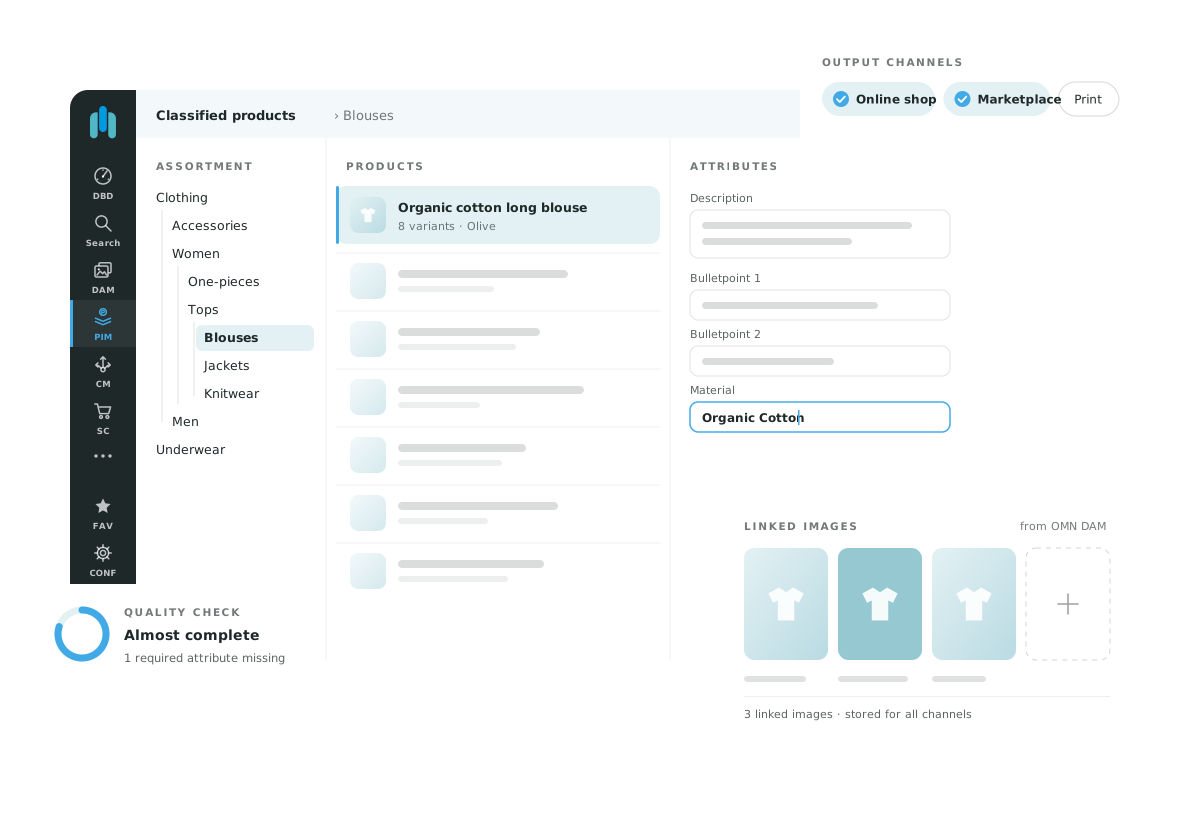
How does OMN support product data syndication?
OMN keeps your product data in one central source and handles syndication in the same platform: via the integrated Channel Management you define export profiles and product data feeds per channel — from your own store to marketplaces, data pools and retailer portals. Transformations and mappings bring the data into the format and structure each recipient requires, and completeness and quality checks run before every export. You maintain data once and publish it everywhere, current and consistent. Experience OMN’s syndication live in a free demo.